
"KNIT a Network! Role Model Roundtable" is a project that invites various guests involved in the world of science and research, and interviews them to talk about their lives, work, and more.
The 8th session, held on Thursday, October 22nd, was presented as "Role Model Roundtable Jr.," with guest speakers Asako Kikuchi, a third-year doctoral student in the Graduate School of Agriculture, and Megumi Sawai, a third-year doctoral student in the Graduate School of Life Science, and interviewer Rina Kurihara, a second-year master's student in the Graduate School of Agriculture. The session was titled "-All About Pursuing a Doctorate-."
The interview with the guest, conducted by Ms. Kurihara, a master's student in the Graduate School of Agriculture at our university, proceeded with questions from the perspective of a peer considering pursuing a doctorate, such as, "Will pursuing a doctorate limit job options?", "What motivated you to pursue a doctoral degree, and what were the benefits?", and "What are your career plans after obtaining your degree?".
I would like to express my gratitude to Mr. Kikuchi and Mr. Sawai for sharing so many valuable insights, and to Mr. Kurihara for his cooperation as an interviewer.
On the day of the event, nearly 30 people participated not only from within our university but also from Kitami Institute of Technology, Muroran Institute of Technology, Obihiro University of Agriculture and Veterinary Medicine, and KNIT joint implementing organizations.
Please see the "Report" below for the rest of the story.
The next KNIT a Network! Researcher Exchange Meeting will be held on November 5th (Thursday) from 12:20 to 12:50, with guests Masayo Ogi and Shoko Wada from the Hokkaido University URA Station.
We look forward to your participation!
For details, please see “Notices from the Career Support Office” onCLICK HERE

Report
Sawai and Kikuchi have advanced to the doctoral program.
When you hear about doctoral programs, you might imagine that only exceptionally talented people pursue them, but both of them say in unison, "I'm not that great."
Nevertheless, I'm still curious about the feelings and motivations of the two who wanted to further deepen their research after completing their master's program and the six-year pharmacist training program.
The interview began with questions about what prompted and motivated them to decide to pursue higher education.
Ms. Sawai, a doctoral student in the Graduate School of Life Science at this university, says that when she was in high school, she faced illness in someone close to her, and her desire to "do something about it" became the starting point for her choices up to the present, including her choice of major.
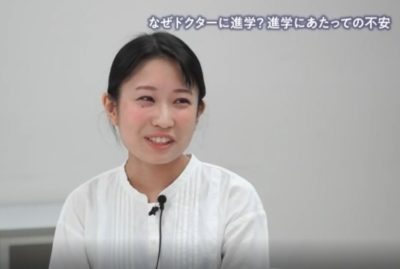
She chose the six-year course to become a pharmacist, but when she returned from her pharmacist internship and picked up a micropipette, she had an intuition that "this is it!" This experience led her to choose to pursue further research instead of graduating.
Similarly, Ms. Kikuchi, a doctoral student in the Graduate School of Agriculture at this university, said that when she was assigned to a research lab and given her research topic, she felt that there was more to this research and wanted to continue it! Her curiosity, along with her desire to become someone who can independently plan and advance research like her seniors in the lab, led her to decide to pursue a doctorate rather than choose employment, because she wanted to advance her research further and learn more about the phenomena related to her research topic.
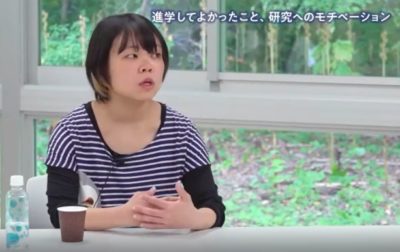
Although they decided to go to college, the two were worried about tuition fees and living expenses.
The solution to this problem was the Special Research Fellowship Program (commonly known as "JSPS") implemented by the Japan Society for the Promotion of Science. Although it is a program with a high competition rate, if you utilize it, you will receive research grants to help you dedicate yourself to research, as well as research expenses.
I entered the doctoral program after experiencing a variety of emotions.
Regarding the benefits of pursuing a doctorate, I mentioned gaining experience in applying for research funding, participating in international conferences, and short-term study abroad programs, which allowed me to learn about the research being conducted by researchers around the world and gave me the confidence to conduct research independently.
The conversation then expanded to include career paths after obtaining a degree.
Regarding the question from Ms. Kurihara, a master's student in the Graduate School of Agriculture at our university, "Wouldn't pursuing a doctorate and specializing limit job opportunities and other options?",

Rather, he wants to work in a job that makes use of his expertise, but he doesn't think there's any difference in options between a master's and a doctoral degree (Sawai).
==
The Office for Promoting a Diversity Research Environment would like to add a few points regarding this matter.
Regarding the concern that "job options will be limited," considering that it is almost impossible to get a job in academia with only a master's degree, it can be argued that a doctoral degree holder, who can challenge for academic positions, will have a wider range of job opportunities.
Whether you have a master's or doctoral degree, the most important thing for finding a job is the ability to set your own research theme and problem, and to judge methods and results. Furthermore, some employers place a strong emphasis on specialized knowledge.
Job placement support for doctoral students is provided by Hokkaido University.Human Resources Development Division S-cubicThis organization also does it.
==
We also asked the two guests about their career plans after obtaining their degrees.
Ms. Kikuchi says she will take a research position at a company because she wants to work alongside peers of the same age and contribute her research technology to society.
Ms. Sawai has a strong desire to create and bring to life things using the technology she has researched, and she is currently looking for a job at a company.
And finally, we received a message for those who are considering pursuing a doctorate.
Ms. Kikuchi said, "If you're struggling, I'd say, 'Why not try pursuing a doctoral degree for three years, thinking of it as learning about adult work?'" and Ms. Sawai added, "I think you should consult with not only seniors but also various adults, and if you still feel like you want to go on to further your studies, then go for it." These two shared messages that only people with experience could offer.
One thing the two of them discussed in common when choosing their career paths was, "Why not include 'getting a doctorate' as an option for your future?"