
"KNIT a Network! Researcher Exchange Meeting" is an event that invites various guests to talk about their lives, work, and other topics related to the diverse jobs involved in university administration, using an interview format.
The first role model roundtable discussion of 2021 was presented as a two-part program titled "Otsuka Award* Special." You can view the interview videos from the program below.
*What is the Otsuka Prize?"Hokkaido University Otsuka Prize"
Interview with Professor Emeritus Eiko Otsuka
We interviewed Professor Emeritus Eiko Otsuka, after whom the "Hokkaido University Otsuka Prize" is named, about her research career and what she would like to convey to the younger generation.
Photo taken in April, 2021
Interview with the Otsuka Prize Winner
2020 Award Winners
From the 10 award recipients, we interviewed 7 who were able to accommodate our scheduled interview dates and times.
Report
On Thursday, May 27th, from 12:20 PM, we presented "2020 Otsuka Prize Special Episode 1: What is the Hokkaido University Otsuka Prize? An Interview with Professor Otsuka," featuring an interview with Professor Emeritus Eiko Otsuka of our university, along with Associate Professor Kaori Shigetomi (Kuribayashi), Specially Appointed Professor of Educational Research at Nitobe College, as a studio guest.
Next week, on Thursday, June 3rd at 12:00, we presented "2020 Otsuka Prize Special Part 2: Interviews with Hokkaido University Otsuka Prize 2020 Award Winners," featuring interviews with seven individuals who actually received the Otsuka Prize in 2020.
Both the first and second sessions had over 40 participants.
Thank you very much to everyone who registered and participated.
In the pre-submitted questions we received prior to the broadcast, we received questions about the future, such as anxieties about life events related to pursuing a doctoral degree, and what one can do after obtaining a doctorate.
The question regarding life events was along the lines of, "Do female researchers have to give up on marriage and childbirth, or is it difficult to balance them?" While the way in which one balances research with life events such as marriage and childbirth varies from person to person, Professor Shigetomi shared her experience, saying, "If you ask whether it's difficult, it's not easy, but there are more enjoyable things than difficult ones." She added, "There were anxieties, but once I got married and had children, I realized that there were surprisingly many people around me I could talk to, and by doing research with those people, I realized that it's okay to rely on those around me more."
In response to the question of what one can do after obtaining a doctoral degree, DJ Fujii from Ree-D shared an interview he conducted with a current doctoral student. He explained that the biggest difference between undergraduate/master's studies and doctoral studies/obtaining a doctoral degree is the level of independence required to conduct research. He suggested that once one obtains a doctoral degree, they will be able to utilize the knowledge-building skills and the ability to proactively set new research challenges to pursue their work and research.
The interview videos from the Knit a Network! Role Model Roundtable Otsuka Award Special, presented in two parts, can also be viewed at the link below.
Otsuka Award Special Interview Video
Please be sure to check out the talk by Professor Eiko Otsuka, as well as the research and doctoral studies of the 2020 Otsuka Prize recipients.
We will continue to hold role model roundtable discussions. Stay tuned!
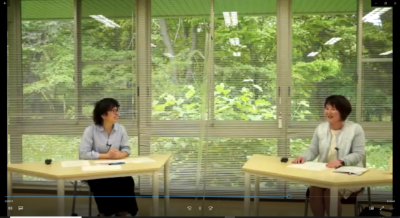
Associate Professor Kaori Shigetomi (Kuribayashi), Specially Appointed Professor at the Department of Education and Research, Nitobe College (right), and DJ Fujii of Ree-D (May 27)