
The Office for Promoting a Diversity Research Environment states:Support Program for Departmental and Organizational Initiatives to Promote a Diverse Research Environment"(Applications for the 2021 academic year are now closed.As part of this initiative, we support the costs of holding training sessions and seminars related to diversity promotion planned and organized by various departments at Hokkaido University.
With this support, the Institute for Media and Communication Studies will host the following events on November 10, 17, 22, and December 1, 2021.BBL SeminarThe event was held online.
Seminar name: Brown Bag Lunch Meeting (BBL)
Is your workplace becoming more internationalized?
-Please share your thoughts on diversity and the internationalization of universities-
Number of participants: Approximately 120 people
Below, we present the report.
Report
This program aimed to (1) confirm whether researchers' overseas experience is being utilized to improve the environment for internationalization at Hokkaido University, (2) identify areas for improvement and challenges, and (3) build a network among stakeholders interested in internationalization. To achieve this, three online seminars (Brown Bag Lunch (BBL) meetings and Zoom conferences) were planned and held during the daytime, which was considered to be relatively convenient for participants.
The target audience included foreign researchers, international students, Japanese students, and the general public. This was done to accommodate the families of foreign staff members, given the current COVID-19 pandemic which tends to disrupt social connections, and to ensure the participation of those affiliated with Kitami Institute of Technology, where one of the seminar's organizers works.
The presenters did not assume that "internationalization equals English," and in order to attract foreigners, international students, and Japanese participants who were not confident in their English level, they announced that the main language of the seminar would be English, but that Japanese support would be available.
We invited two speakers to the seminar. First, Professor Mazur (Assistant Professor, Institute for the Advancement of Higher Education, Hokkaido University) gave a lecture on how one's own cultural background and common sense can sometimes lead to misunderstandings, drawing on the culture shock he experienced when he first came to Japan and numerous examples from his experiences abroad.
Next, Professor Auri (Lecturer at Chiba University, Representative of New Face of Japan) answered interview questions on the theme of "How can people from different cultural backgrounds build trust and connections?" In the interview, he explained, using concrete examples of people participating in his project, that (1) emotions connect us across borders, (2) places and environments where emotions can be shared are necessary for a society where people feel connected, and (3) nationality does not necessarily coincide with our culture and values.
Following these lectures, the seminar included a networking session where participants introduced themselves and shared their experiences. The networking sessions were conducted in randomly formed groups of five or six people, but due to the limited time, many participants felt it was insufficient. However, there were instances of simultaneous interpretation by the presenters and participants helping each other with language, demonstrating a proactive approach to intercultural exchange throughout the seminar. The simultaneous interpretation, in particular, was provided by a researcher with overseas experience, who not only possessed language skills but also leveraged their research background to effectively convey the intentions of people from diverse backgrounds. One participant commented that the simultaneous interpretation made the seminar more meaningful. Additionally, Professor Auri's interview was made available on YouTube with Japanese subtitles (limited access).
A survey of participants regarding the impact of the seminar revealed that foreign researchers need a place and network where they can gather to exchange information not only on work-related matters but also on aspects of their lives. The presenters provided a place where interested individuals could contact each other at any time using the communication tool Slack. How this tool will be used in the future depends on the participants, but the team is steadily growing (currently 10 members as of December 2nd, the second day since its launch). In addition, about 30 high school students also participated in the seminar, and an exchange occurred where foreign Hokkaido University staff members kindly proofread essays written by the high school students about their experiences studying abroad in the United States. This exchange, which took place between high school students and Hokkaido University staff members who met for the first time at the seminar, strongly demonstrated the importance of a place for diverse people to meet and interact. Furthermore, a fourth seminar, which was not originally planned, was held during lunchtime at the request of those who wanted to participate.
In summary, this participatory seminar brought together approximately 120 people interested in internationalization, who shared a strong interest in internationalization and networking, as well as the challenges of intercultural exchange. During the meeting, there was a very strong call for a place for exchange and information sharing that transcends national and linguistic boundaries, and it was emphasized that opportunities to discover each other's cultural backgrounds and commonalities are necessary for internationalization. The challenge going forward is how to further develop the connections among the participants, including the presenters, in a way that aligns with everyone's aspirations.
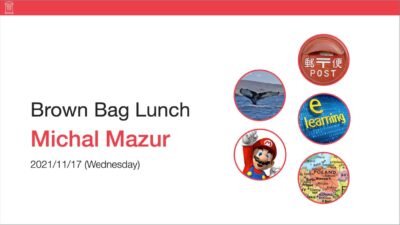
Presentation cover by Professor Mazle
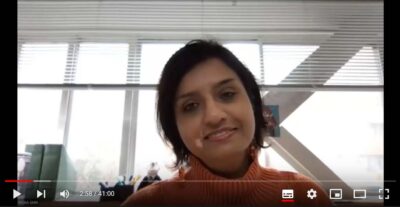
An interview with Professor Auri on the theme of "How can people from different cultural backgrounds build trust and connections?"