
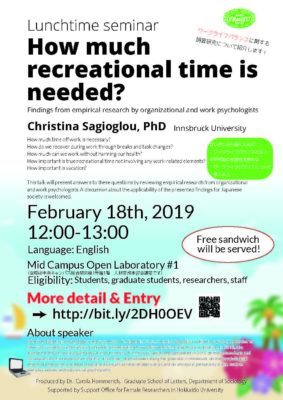
Main topic
How much recreation time is necessary to maintain a work-life balance?
Organizational psychologist at the University of Innsbruck, AustriaDr. Christina SagioglouNext, we will introduce various research data on work-life balance for a more fulfilling work life.
Let's consider work-life balance to improve researchers' productivity.
Please apply using the web form below.
Application Form
Contents
- How much time off work is necessary?
- How do we recover during work through breaks and task changes?
- How much can we work without harming our health?
- How important is true recreational time not involving any work-related elements?
- How important is vacation?
The present talk will present answers to these questions by reviewing mostly European and North American empirical research from organizational and work psychologists. Although many of the findings apply to most types of employment, there will be an additional focus on factors relating to the work-life balance of researchers. The structure and content of the talk is based on a chapter in a book recently published by a leading professor for work psychology at the presenter's university (Jürgen Glaser, University of Innsbruck). A discussion about the applicability of the presented findings for Japanese society is welcomed.
After her diploma in psychology at the University of Cologne in 2010, Christina Sagioglou worked as a junior researcher at New York University and Hamburg University investigating how positive thinking affects our motivation. In 2012, she started her PhD in social psychology at the University of Innsbruck, which she completed in 2015 on the antecedents and consequences of interpersonal hostility. Since then, she has been doing her post-doc in Innsbruck on the psychological effects of phenomena related to social status such as relative deprivation and on antisocial personality traits, such as everyday sadism and subclinical psychopathy. Recently, she spent 6 months at Hokkaido University, where she started to collaborate with Masaki Yuki on cultural differences in the need to belong and with Carola Hommerich on a project investigating relative deprivation and well-being in an intercultural context. Her most research work in progress investigates the novel personality trait "benign masochism" – the uniquely human characteristic of being able to gain pleasure through essentially negative experiences such as pain, Sad novels or spicy food.
Please apply using the web form below.
Application Form
| Day and time | 2019/2/18 (Monday) 12:00-13:00 |
|---|---|
| place | Conference Room, 1st Floor, Building 1, General Research Building, Central Campus, Hokkaido University, Kita 12-jo Nishi 7-chome, Kita-ku, Sapporo City |
| language | English |
| Target | Open to students, graduate students, researchers, and staff affiliated with this university, regardless of gender. No entry fee |
| Capacity | 20 |
| Deadline | Thursday, February 14, 2019, 2:15 PM (Registration will close once the maximum number of participants is reached) |