
Creating a diverse research environment begins with understanding our own bodies and respecting the physical and mental well-being of others.
Ree-D believes that understanding our own minds and bodies, and respecting the circumstances and lifestyles of others, are prerequisites for realizing a diversity research environment.
Daily life involves family life events and changes in your own or your family's health, which may require adjustments to your research, studies, or work.
According to a survey on the current state of health promotion for working women, 43% of respondents answered that they had "experienced having to give up something at work" due to health issues specific to women.

Figure 31 [Female Employees] Whether or not they have felt they have had to give up something at work due to health issues specific to women (n=2400) Quoted and adapted from Ministry of Economy, Trade and Industry document "Initiatives for Women's Health in Health Management, March 3"
So, when you hear the phrase "health issues specific to women," what comes to mind?
Figure 2 shows a comparison of awareness rates between men and women regarding social issues related to women's health. It reveals a difference in awareness rates between men and women, with women's awareness rates being particularly low.
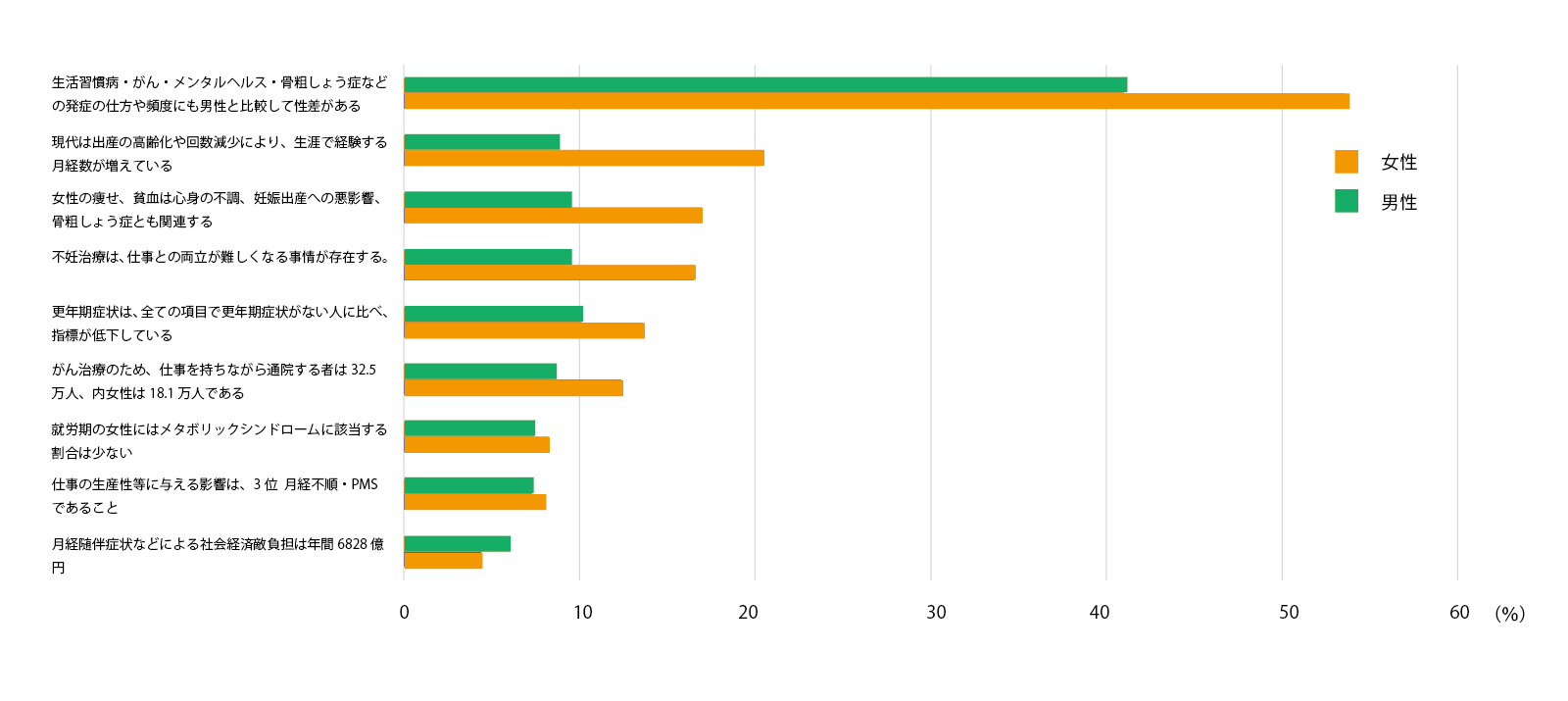
Figure 2. Awareness of social issues related to women's health (percentages are those who are aware/n; women n=2452, men n=1748). Quoted and modified from the Ministry of Economy, Trade and Industry's "FY2017 Health Life Expectancy Extension Industry Creation Promotion Project (Health Management Dissemination and Environmental Improvement Project) Survey Report".
In order to create an environment where each individual can take pride in themselves and challenge their own potential, it is essential that everyone, regardless of gender, understands that physical characteristics and health differ by gender and generation.
What Ree-D and each of us can do to create a diverse research environment.
Knowing what kind of health and physical changes can be expected throughout life, and what systems and support are available at those times, before you actually experience them, brings you one step closer to realizing the future you want.
Therefore, “Career and Reproductive Health/Rights[1]*International Conference on Population and Development (ICPD)/Cairo Conference, September 1994A concept that was first officially proposed in [location/region].I will be serializing a five-part series in the Ree-D column titled "Tips for Thinking About the Future You Want to Create."
Part 2: Men's Knowledge You Should Know About Menstruation
Part 3: Knowledge about sex hormones secreted in both men and women
The 4th Preconception: Pregnancy, Childbirth, and Welfare Benefits
Fifth installment: Life and Career Design – Modern Reproductive Medicine
*The title may be subject to change.
Reproductive health and rights refer to a state of complete physical, mental, and social well-being, encompassing not only the absence of disease and disability in all aspects of the human reproductive system, but also overall well-being.
To share topics that have rarely been discussed across genders and generations, and to realize a research environment that respects and includes each other's "reproductive health/rights" (i.e., diversity), we will start by sharing what we want each individual to know.
Footnote
| 1↑ | *International Conference on Population and Development (ICPD)/Cairo Conference, September 1994A concept that was first officially proposed in [location/region]. |
|---|