
Part 3: Knowledge about sex hormones that men should also know
Regarding careers and reproductive health/rights,
I'd like to think about this together with the members who gather at CAFE Ebi.
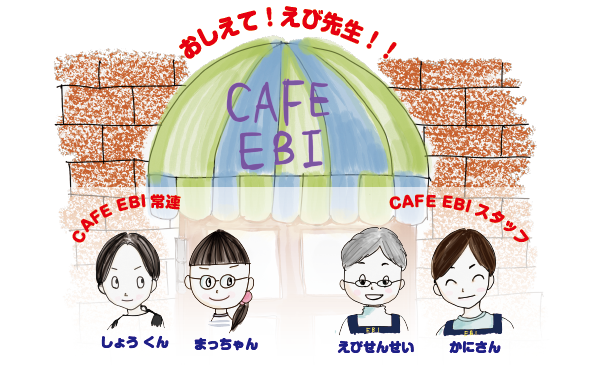
Ebi-sensei: The owner of CAFE EBI.
She changed careers from being an obstetrician and gynecologist to opening her long-desired coffee shop.
I enjoy chatting with my partner, Kani-san, whom I call "wife," and with customers.
Kani-san: Kitchen leader at CAFE EBI.
Originally, he was a researcher in a field completely unrelated to food,
I wanted to provide delicious food, so I changed careers with Ebi-sensei.
Macchan: A regular customer at CAFE EBI. Works as a researcher in a lab. Sho-kun is his partner.
Lately, I've been hearing a lot of reports about life events from my classmates.
I am conscious of my life and career plan.
Sho-kun: A regular customer at CAFE EBI. He works as a researcher in a lab. Macchan is his partner.
I learned about the concept of reproductive health/rights from Professor Ebi.
Studying.
*All characters are fictional.
Take home message
When your physical condition changes, hormone secretion also changes.
TOPIC
1. Menstrual cycle and sex hormones
2. The body and sex hormones as menopause approaches
3. Changes in hormone balance - When your mind and body become unwell -

Dr. Ebi, you talked to me a lot about menstruation the other day, but why do stress and sudden weight changes affect menstruation, and why do moods change during the menstrual cycle?

Well, that can sometimes be related to sex hormones.
What did you tell me about first, female hormones and male hormones?
That's right. Sex hormones aren't just estrogen and testosterone, as we talked about before; there are many other types, and they work together to maintain reproductive function. So today, let's talk about the relationship between sex hormones and the body.
The relationship between sex hormones and mind and body - hormone balance and the autonomic nervous system -
1. Menstrual cycle and sex hormones
The menstrual cycle is generally said to be 28 days, but it varies from person to person.
The menstrual cycle is regulated by a complex interaction of the hypothalamus-anterior pituitary-ovarian system. The hypothalamus secretes gonadotropin-releasing hormone (GnRH), which stimulates the anterior pituitary gland to secrete gonadotropins LH and FSH. These gonadotropins stimulate the ovaries to secrete the gonadosteroid hormones estrogen and progesterone. Hormones have a feedback mechanism with the anterior pituitary gland and hypothalamus, and these are what regulate the cycle.
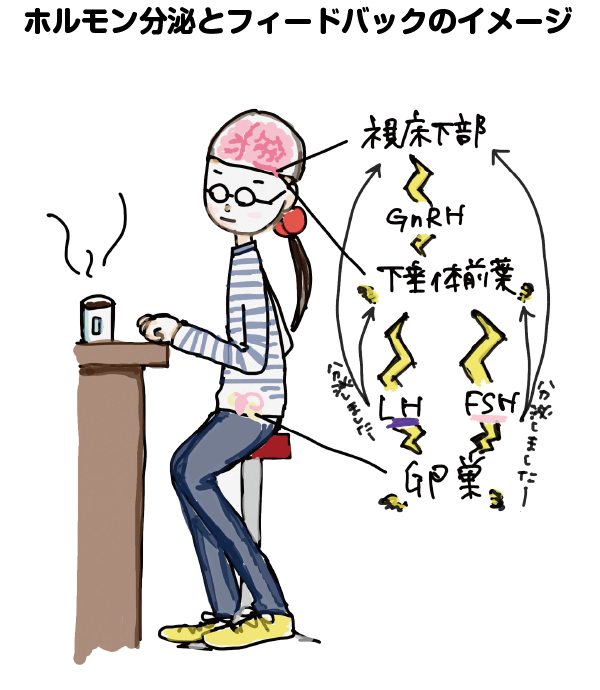
Looking at it in more detail (See Figure 1FSH levels begin to rise before the start of menstruation, and LH levels also begin to increase. This promotes follicular development and increases estrogen production. The rapid increase in estrogen secretion just before ovulation triggers an LH surge (rapid rise), which causes ovulation. The follicle that released the egg transforms into a corpus luteum, which then produces progesterone.
Progesterone's central nervous system action causes body temperature to rise. Basal body temperature captures this change. In other words, body temperature rises after ovulation and then drops during the next menstrual period.
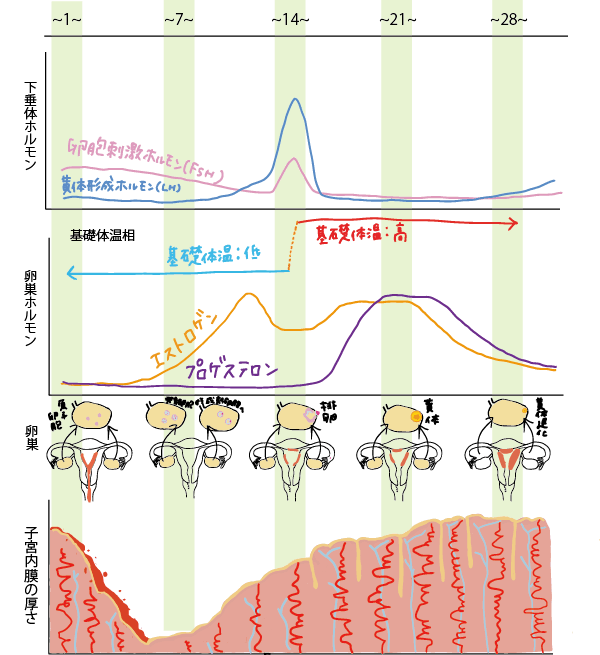
Figure 1: Relationship between ovulation, menstruation, and hormone secretion
Japan Society of Obstetrics and Gynecology, Women's Health Q&A, Adolescence: Answer to the question "Menstruation (Period): Please tell me about menstruation."Quoted and modified from
2. The body and sex hormones as menopause approaches
Around the time of menopause, the amount of female hormones that were being secreted decreases.
Menopause, the cessation of menstruation, typically occurs around the age of 50-51. This is due to the loss of follicles due to aging, but we'll talk about the lifetime egg count another time. In your 40s, the number of follicles decreases, estrogen production declines, and menopause occurs. Low estrogen levels continue after menopause, but during perimenopause, a transitional period with hormonal changes, symptoms that interfere with daily life, known as menopausal disorders, are common. Menopausal disorders can manifest in a variety of symptoms, including autonomic nervous system symptoms such as hot flashes and chills, and mental symptoms such as insomnia and depression.
These symptoms are linked to psychological and personality factors such as feelings of loss as a woman and anxiety about the future, as well as social and environmental factors such as family and work. That's why there's a lot of individual variation in symptoms. Just like with menstruation, if you're feeling unwell during menopause, don't hesitate to consult a gynecologist. They'll help you.
3. Changes in hormone balance – when your mind and body become unwell.
While changes within the menstrual cycle are certainly a factor, looking at it more broadly, women's physical and mental health is prone to problems when female hormone secretion changes throughout their life cycle. You know about menopausal symptoms that occur around the time of menopause, right? After childbirth, there is also a rapid decrease in female hormones, and many women experience mental health problems due to this, combined with environmental changes such as childcare. In addition, stress on the body from changes in living environment or weight can easily lead to irregular menstruation.
Are there no hormonal effects due to age in men?
Men can also experience symptoms known as male menopause. If these symptoms significantly interfere with daily life, a urologist is the appropriate specialist.

Sometimes I wonder why women have so many bodily events, but then I forget that we are human beings. But as Ebi-san is teaching us now, humans can understand the mechanisms and live in consultation with their own desires.
That's right. Understanding your body, including hormone balance, is crucial in reproductive health. Knowing about it might allow you to appreciate the diversity of other people's bodies and desires.
Take good care of your body and maintain it.
-Understanding your own mind and body and maintaining well-being leads to everyone's well-being-

It's true that women have more biological functions than men that affect their physical condition. And the periods when sex hormone secretion changes, meaning when physical condition is more easily affected, sometimes coincide with times when you're entrusted with important work and feel pressure. In my case, I used to think, "Why me?!" but actually, although the degree of how it feels varies, I'm not "alone." Not only other women, but men aren't always in perfect health either, and they're exposed to all sorts of pressure.
Hormonal fluctuations and physical discomfort are unavoidable, so one option is to wait for them to pass. When you feel "distressed," whether physically or emotionally, it's okay to seek help from a gynecologist. You can receive the best possible care for your specific life stage.
That's right. Sometimes I think to myself whether it's okay to wait for it to pass, or if it's different from usual, and I also chat with friends I can talk to about my health and physical condition. It helps me to look at my own health objectively, and sometimes I learn things I didn't know before by listening to other people's stories, and it's reassuring to know that I'm not alone. It feels like my secret to good health can be useful as someone else's secret to good health.

But I don't have many friends I can easily talk to about my health.

It's a private matter, so that's perfectly normal.[1]At the Health Center on the Sapporo Campus of Hokkaido University,Counseling for female studentsWe have established.
The self-check website created by a research team at the Ministry of Health, Labour and Welfare also allows you to search for medical institutions.[2]Women's Health Promotion Office Healthcare Lab (supervised by the Ministry of Health, Labour and Welfare Research Group (Fujii Group, Faculty of Medicine, University of Tokyo))
I think that knowing your own mind and body and maintaining well-being can lead to everyone's well-being as well.
(Supervised by: Yasuhiko Ebina, Professor, Graduate School of Health Sciences, Hokkaido University)
Footnote
| 1↑ | At the Health Center on the Sapporo Campus of Hokkaido University,Counseling for female studentsWe have established. |
|---|---|
| 2↑ | Women's Health Promotion Office Healthcare Lab (supervised by the Ministry of Health, Labour and Welfare Research Group (Fujii Group, Faculty of Medicine, University of Tokyo)) |