
"Survey Report on Childcare Environment for Foreign Researchers and International Students"
In May 2016, the Office for Supporting Female Researchers, in cooperation with the University's International Headquarters, conducted a "Survey on Childcare Environments for Foreign Faculty Members and International Students."
Method of implementation
Format: Web survey
Dissemination methods: Request for notification to departments, mailing list and posters for international students at the International Headquarters, mailing list for the Women Researchers Support Office
Response period: May 12, 2016 - May 25, 2016
Result I: Attributes and Family/Children's Situation
Number of responses
154 people (82 women (53%), 72 men (47%))
This is not just a women's issue, but a family issue that includes men as well.
Status/position
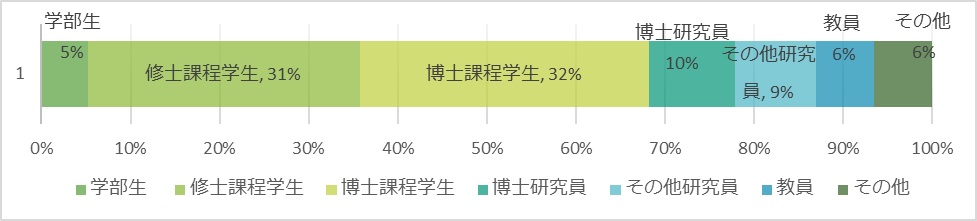
The main respondents were students, accounting for approximately 70% of the total. In particular, master's and doctoral students made up over 30%.
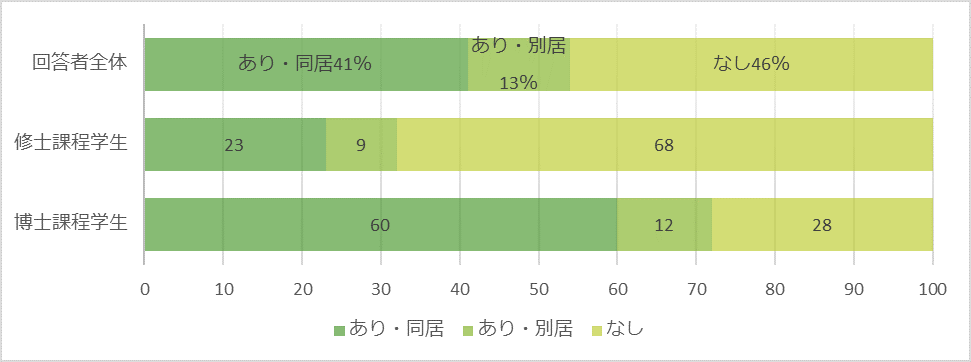
Family situation - whether or not you have a partner, and whether you live together or separately.
Percentage of respondents who have children
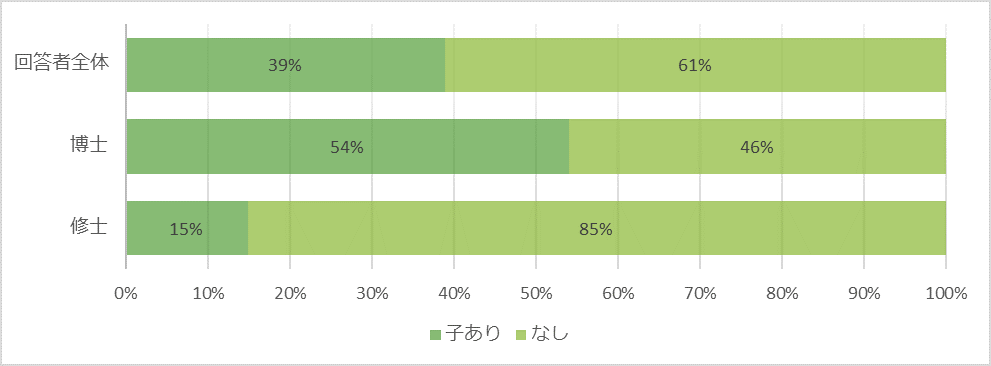
Of the 154 respondents, 60 were foreigners with children.
Focusing particularly on master's and doctoral students, 32% of master's students had a partner, and 15% had children.Among doctoral students, 72% had a partner, and 54% had children.This reveals a picture of international students that differs from the typical image of "international students = living alone."
Furthermore, 60-70% of the researchers and faculty members who responded were raising children.
If you have children, the number of children
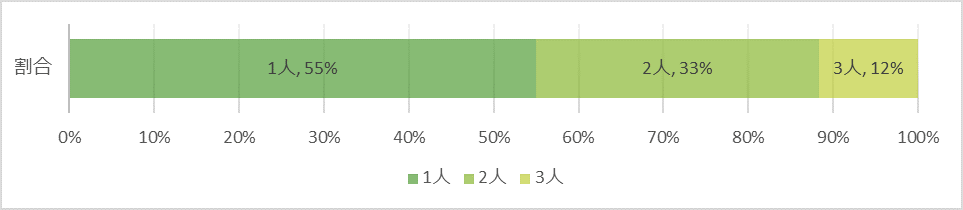
Total number of children among the 154 respondents: 94
Childcare situation
Total number of children among 154 respondents: 94; Number of preschool children living at home: 71
Breakdown of childcare situation for preschool children living at home
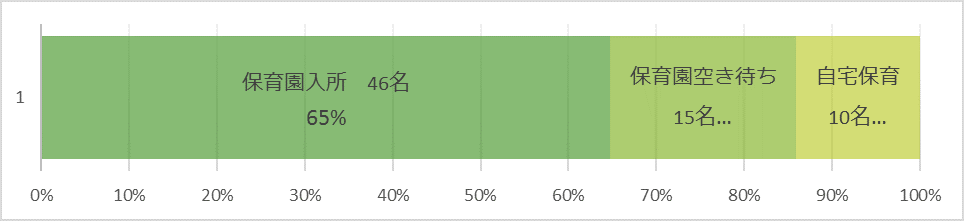
71 preschool children living together, of which46 children enrolled in daycare, 15 still searching for daycare.
⇒86% of the preschool-aged children living at home required daycare.
(Note) Of the eight people who are currently living separately from their children, six wish to live together (the reason for their current separation is unknown).
(Reference) Total number of children that can be accommodated at the on-campus daycare center: Currently 170
Results II: Difficulties encountered regarding nursery school enrollment
Question: "Have you ever had any difficulties finding a daycare center, with the application process, or with communication?"
⇒39 respondents (27 with experience (approx. 70%), 12 without experience (approx. 30%))
Written answer content
A. Difficulties encountered when enrolling in daycare
- Information acquisition and communication (language barrier): 11 cases
- No openings at the nursery school, so I was unable to enroll my child at the desired time or school: 8 cases
B. Problems encountered after enrolling in daycare
Language barrier: 13 cases
- Unable to get into the desired nursery school (too far away and difficult to commute, siblings cannot attend the same nursery school): 5 cases
C. Any difficulties or information you would like to know about raising children in Japan in general.
Language barrier (conversation, printed materials): 21 cases
- Childcare system (wanting to enroll before arriving in Japan, cost concerns, etc.): 10 responses
⇒Similar to the results of the case study survey conducted in December 2014 involving the administrative staff of this faculty and foreign support organizations (described below).
- Difficulty gathering information when searching for a daycare center, language barriers in communication with government officials and daycare centers.
Background
I. Cases of consultations regarding childcare and nurseries from foreign students enrolled at this university
Case studies of departmental administration and external support organizations
In November 2014, the medical interpreting group SEMI informed us that they were receiving many inquiries regarding childcare (nursery and daycare) from young foreign students (researchers and international students) affiliated with the university. Therefore, in December 2014, we conducted a survey targeting SEMI, IWC, and various departments regarding "whether and what kind of inquiries foreign students at the university had made regarding childcare (over the past five years)." As a result, we collected a total of 53 cases: 14 from within the university and 39 from SEMI. In particular, inquiries were concentrated at the medical interpreting organization SEMI, and it became clear that, to date, free accompanying interpreting support had been provided through the goodwill of individual SEMI members.
The types of inquiries received were mainly:
1. I don't know how to find a daycare center (the language barrier is the underlying reason).
2. We applied, but there are no openings, so we cannot enroll → This will interfere with the child's studies and the partner's studies/employment.
3. After enrolling my child in daycare, I sometimes have trouble communicating with the daycare center.
They were classified into three categories.
Consultation with the Office for Supporting Female Researchers (April 27.4 onwards)
Since April 27, there have been four direct inquiries from foreign nationals to the support office via telephone, email, or in person. Two of these inquiries concerned the fact that they had applied for admission to a nursery school but were unable to enroll due to a lack of openings. There were also four inquiries from departmental administrative staff or faculty members in accepting research laboratories. The Faculty of Engineering and the Faculty of Agriculture reported instances where departmental administrative staff accompanied students to nursery schools or elementary schools for admission procedures. Given the expected increase in the number of foreign students and researchers in the future, it has been suggested that individual support such as departmental staff accompanying students will be extremely difficult, and that a university-wide support system may be necessary.
Accompanying interpreter support for nursery school enrollment
It has come to light that, in the case of children of international students and others entering daycare centers, accompanying interpretation support was being provided free of charge through the goodwill of individual members of an external organization, SEMI. Therefore, in order to establish a university support system, the Women Researchers Support Office took charge of this matter and, in cooperation with SEMI and IWC, launched the FResHU Supporter system, which provides accompanying interpretation support for daycare center enrollment procedures. Volunteers from SEMI and IWC were registered as interpreters. When interpretation is provided by a supporter, an honorarium is paid from the support office's budget, making it a paid volunteer service. (Trial period from December 26.12, officially started in April 28.4) The number of cases implemented to date is:
December 26.12 to March 28 (trial period):
April 28.4 to March 29.3: 28 items
Therefore, since the payment of honorariums to supporters had to be covered within the budget allocated to the support office, they had no choice but to refrain from extensive publicity. As a result, it is expected that the number of implementations will be less than the actual need.
II. Challenges in the Hokkaido Universal Campus Initiative (Hokkaido University Super Global University Project)
In the Super Global Project, Hokkaido University has set the goal of "contributing to solving global challenges," and has specified increasing the proportion of foreign faculty, female faculty, and international students as performance indicators. Specifically, the following items will be implemented to create an environment that can accommodate more foreigners.
Excerpt from the conceptual document
○ Create an environment where international students can concentrate on their studies with peace of mind.
<Challenge>
A. The division of roles within the university regarding support for international students is not clearly defined.
(i) Lack of cooperation with various external organizations (local governments, NPOs, community volunteers)
(c) Insufficient support for international students before they arrive in Japan, and insufficient support for their families.
<Initiatives to address the challenges (planned)>
(Initiative 3) As support for the families of international students, etc., assistance will be provided to help them establish their lives in Japan immediately after arriving, to help them access public services such as government offices and hospitals, to expand cooperation with the Sapporo English Medical Interpreter Group mentioned above (2014), to collect information from Sapporo City and relevant elementary schools, etc., and to provide information from the university (2014), and to support consultations with schools, etc., so that children can start school smoothly (2015).
To achieve this, the International Headquarters (International Cooperation Organization), which has been providing support for the lives of foreigners, and the Women Researchers Support Office of the Human Resources Development Headquarters, which has been providing consultations, particularly regarding balancing childcare with studies/research such as finding childcare facilities, have decided to cooperate in conducting a survey on the common issue of "childcare environment."