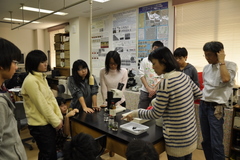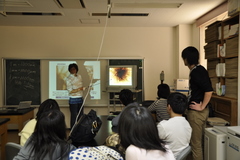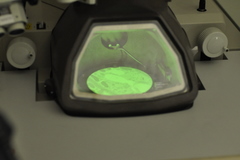
The second cohort of Hokkaido University's "Future Scientists Training Program" has begun their research in university laboratories, and on November 20th and 21st, they participated in a program called "Field Adventure Pro," which involved visits and practical training at research fields and facilities related to Hokkaido University.
November 20th (Day 1)
Tomakomai: "Burying Carbon Dioxide! ~CO2 Underground Storage Demonstration Test~"
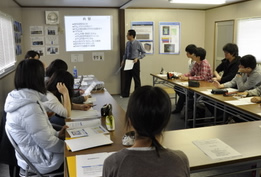
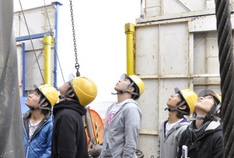
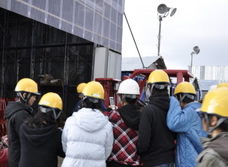
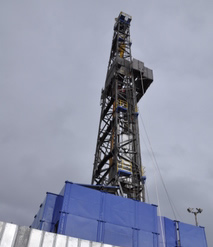
In Tomakomai, wells are being drilled for research into a project (CCS) to capture carbon dioxide emitted from factories and other sources and store it underground. During the bus ride to Tomakomai, Professor Takashi Ikeda of the Faculty of Science gave a lecture on geophysics. After arriving at the site and receiving lectures on CCS and global warming, we toured the extremely deep drilling site (approximately 3000m), a sight rarely seen by the public.
Tomakomai: "Viewing the Far Reaches of the Universe via Radio Waves"
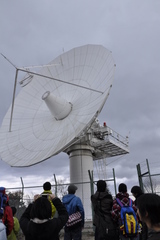
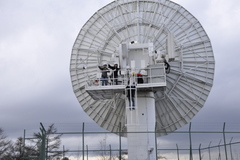
Hokkaido University has an 11-meter diameter radio telescope in Tomakomai. Assistant Professor Kazuo Sorai and graduate students from the Faculty of Science gave us an explanation. We climbed up onto the radio telescope and looked inside the antenna, and received an explanation of data analysis.
Lake Toya: "Lake Toya Hot Springs and Volcanoes" and "A Life as a Researcher"
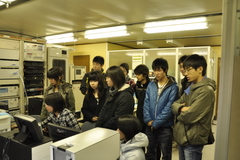
After dinner at a hotel in Lake Toya, there was a lecture by a graduate student from the Faculty of Science about the hot spring water of Lake Toya, and a talk by Associate Professor Goto of the Women Researchers Support Office about the profession of a researcher. Professor Goto, in particular, spoke candidly about her own experiences as a researcher, which led to active questions and discussions from the high school students.
November 21st
Mount Usu: "Let's listen to the Earth's heartbeat" and "Tephronicology"
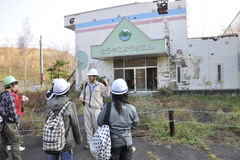
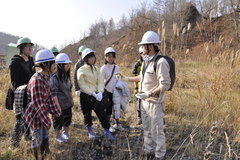
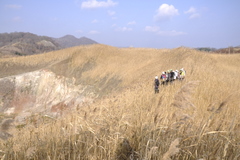
At Mount Usu, guided by researcher Yugo Nakamura of the Hokkaido University Earthquake and Volcano Research Observation Center, we observed the lingering scars of the 2000 eruption, as well as its distinctive geological features and topography. With special permission, we were able to visit areas that are normally inaccessible. The terrain had been uplifted and subsided due to volcanic activity, making walking extremely difficult, and we truly felt the immense power of the volcano.
After descending Mount Usu, we had a lecture by Professor Nakamura on "Teplochronology." This involves determining geological ages from volcanic ash in rock layers, and the students were very interested in this field of study, which they had never heard of before.
Muroran: "Seaweed from Hokkaido"
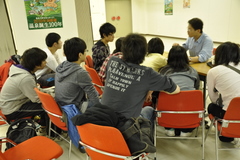
At the Muroran Marine Biological Station of Hokkaido University in Muroran City, Professor Taizo Motomura of the Northern Biosphere Field Science Center gave a lecture and conducted experiments on seaweed in Hokkaido. We were able to hear about a wide variety of research topics, including the relationship between seaweed and the global environment and the pigments of seaweed. We also had a practical session where we observed seaweed cells using a transmission electron microscope. The students were very excited to be able to observe the internal structure of cells, which they had only ever seen in textbook diagrams, right before their eyes.